

- Talent pool
- Academic potential
- 2.1 M people in the range of 25 km & 8.5 M citizens in the range of 100 km from Katowice
- 1,701 people/sq km in Katowice & 839 people/sq km – population density for Metropolis – significantly higher than the average for Poland (122 people/sq km)
- 19 universities and 95,817 students and 23,377 graduates annually in Metropolis
- Over 90% students can speak English and over 7,000 students participate in foreign philology studies programs
- 38 different foreign languages are used in business service centers
- over 250,000 companies in Metropolis, 58,609 in Katowice where work well-educated people
- 38,700 people employed in business services sector in 165 centers BPO, SSC/GBS, IT and R&D
In Katowice, we implement educational projects, including:
THE ‘CORPORATE READINESS CERTIFICATE’ (CRC) project, launched in Katowice in 2013. Project partners include Accenture, EY, ING Hubs Poland, and Kyndryl. The CRC is targeted at university students and aims to support the development of competencies and skills in IT and business services. Training sessions are delivered by the project partners and are free of charge for participants. The program concludes with an exam, and successful participants receive a certificate.
P-TECH – a global program created by IBM, implemented in Katowice at two secondary schools between 2019 and 2023/24 by Fujitsu and IBM, and subsequently by Kyndryl. Following the conclusion of the program, both companies – Fujitsu and Kyndryl – have continued their cooperation with the schools, developing original, proprietary educational initiatives.
The FUJITSU Tech Programme is an innovative initiative addressed to upper secondary school students, aimed at effectively preparing young people for the rapidly evolving labour market in the IT sector. The programme equips students with the skills and competencies needed to meet the challenges and opportunities offered by modern technologies. Thanks to the substantive support of our Partner, Fujitsu Poland, programme participants have the opportunity to explore key areas of IT such as Cybersecurity, Artificial Intelligence (AI), Python programming, and Virtualization. These are among the most in-demand skills sought by today’s employers. Last year’s edition of the programme was a great success at Śląskie Techniczne Zakłady Naukowe. Over one hundred students from five IT-focused classes took part in more than 150 hours of lectures and mentoring sessions delivered by Fujitsu experts. In addition, seven students had the opportunity to gain valuable hands-on experience through professional internships at the Fujitsu office.
KYNDRYL Future Achievers, implemented in Katowice since 2023, is a proprietary educational project of Kyndryl. Similar to FUJITSU-Tech, it is addressed to secondary school students and covers IT-related topics such as artificial intelligence, mainframe systems, design thinking, project management, cloud computing, and mindfulness, combined with a mentoring programme. Participants include students of Liceum Ogólnokształcące im. Maczka and Zespół Szkół Poligraficzno-Mechanicznych in Katowice.
TECHNOLOGICAL CAREER COMPASS – Sopra Steria – an educational programme implemented by Sopra Steria under the patronage of Katowice City – live, work & invest, dedicated to upper secondary school students. Its aim is to support young people in making informed career decisions and developing future-oriented skills. As part of the programme, technology experts deliver lectures and workshops covering topics such as artificial intelligence, cybersecurity, programming, IT career paths, and future skills. During the first edition, 78 lectures and workshops were delivered over 28 days of activities. The programme currently engages around 550 students from four secondary schools in Katowice: Zespół Szkół Technicznych i Ogólnokształcących Nr 2, Zespół Szkół Ogólnokształcących Nr 1, VI Liceum Ogólnokształcące, and Zespół Szkół Poligraficzno-Mechanicznych. The initiative is supported by 15 technology experts from Sopra Steria.
CIVICPUNK: Culture of Innovation
is an educational initiative addressed to students of Katowice secondary schools, aimed at developing technological and leadership competences through work on real social and urban challenges. The project combines learning modern technologies with systems thinking, project-based work and teamwork. It also builds key business skills, including presentation, brand building, product management, project management and leadership. Participants gain practical competences in areas such as digital solutions, data analysis and modern IT tools. The outcomes of their work include tangible project deliverables, such as prototypes of digital systems supporting, among others, logistics, efficient resource management, as well as educational and knowledge-exchange platforms – all developed in conditions reflecting a real-world project environment.
THE ‘KATOWICE, BUSINESS, AND MY FUTURE’ project, implemented in Katowice since 2022, is addressed to third- and fourth-year secondary school students. Project partners include Ammega, Honeywell, Accenture, Kyndryl, Sii, as well as TDJ-Famur, Arche Consulting, Randstad, Hays Poland, and Manpower. The project focuses on organising expert-led meetings at schools and presenting career development opportunities within partner companies. HR experts involved in the project discuss recruitment processes and engage students in discussions on topics such as future competencies, labour market trends, future career paths, and building a professional CV.
THE ‘KATOWICE – CITY OF PROFESSIONALS’ programme aims to promote education in vocational and technical schools, enhance the attractiveness of this form of education, and highlight related career prospects. The programme is implemented according to the following structure: Stage I – Introductory lesson at school; Stage II – Study visit to a company; Stage III – Visit to a technical or first-degree vocational school; Stage IV – Final summary lesson.
*The Metropolis is composed of Katowice and 40 towns and municipalities: Będzin, Bieruń, Bobrowniki, Bojszowy, Bytom, Chełm Śląski, Chorzów, Czeladź, Dąbrowa Górnicza, Gierałtowice, Gliwice, Imielin, Knurów, Kobiór, Lędziny, Łaziska Górne, Mierzęcice, Mikołów, Mysłowice, Ożarowice, Piekary Śląskie, Pilchowice, Psary, Pyskowice, Radzionków, Ruda Śląska, Rudziniec, Siemianowice Śląskie, Siewierz, Sławków, Sosnowiec, Sośnicowice, Świerklaniec, Świętochłowice, Tarnowskie Góry, Tychy, Wojkowice, Wyry, Zabrze, Zbrosławice.
Talent pool
Potential of the Metropolis is based on 95,817 students, including 50,321 in Katowice, studying at 19 universities.
The dominant fields of study include:
- business and administration (nearly 15,000 students),
- broadly defined ICT (Information and Communication Technologies) fields (over 9,000 students),
- engineering and technical disciplines (close to 8,000 students).
The most dynamic universities in the Silesia region include: the University of Silesia, the University of Economics in Katowice, the Silesian University of Technology, and the Medical University of Silesia.
Fields of study
At universities, many faculties are created to educate students/graduates in faculties that respond to the needs of ITO, BPO, SSC, R&D sectors, e.g.
- IT with Big Data Analytics,
- Cloud Computing,
- Cyber-Physical Systems,
- Mobile application development,
- Analysis of Large Data Sets,
- Gaming, etc.
Finance and Accounting for Business – in English, business logistics or philology: English, German, etc.
In addition, universities carry out various types of cooperation with investors, which aims to acquire new knowledge and gain practical skills.
An example of such cooperation is the Corporate Readiness Certificate educational program run since 2014, in which partners are Kyndryl, Accenture, ING Tech Poland.

University of Silesia

The University of Silesia in Katowice, one of Poland’s largest and fastest-growing universities, offers innovative approaches to education and a supportive environment for conducting research.
University employees, students and young scientists, working individually and in teams, address themes crucial at the regional, national and global level.
A high standard of scientific research conducted, the diversity of the initiatives undertaken, as well as modern infrastructure, all translate into the quality of education. The University systematically develops the educational offer. New programmes and majors that correspond to recent scientific trends and expectations of the labour market are opened annually. Both allow undergraduate and PhD students to pursue their individual interests.
In 2026, nearly 20,000 students are enrolled in 97 degree programs (including 10 taught in English) and 186 specializations (including 13 taught in English and 1 taught in both English and Polish). The University of Silesia collaborates with numerous business, scientific and local government entities, as well as the business community, through nearly 2,000 signed contracts, agreements and letters of intent.
The distinction HR Excellence in Research received from the European Commission, unique infrastructure distinguished in numerous architectural contests, highly rated patent activities of the university or research, educational, artistic and science popularizing initiatives awarded prizes – are just a few facts indicative of the quality of working conditions, education and possibilities of development.
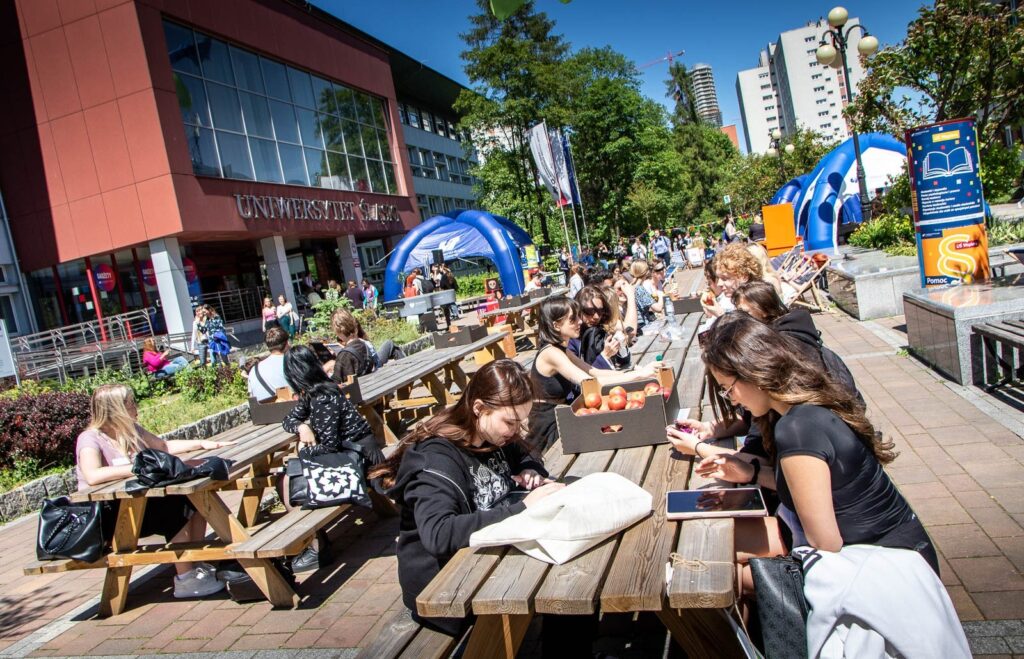
Silesian University of Technology
The Silesian University of Technology (SUT) is a friendly and open university that comprehensively supports its students and helps to develop their passions and interests. Since 2019, the Silesian University of Technology is in the prestigious group of 10 best universities in Poland with the status of a Research University. This is the result of in-depth assessments of an international team of experts checking the university’s potential and research activity.
The university educates in nearly 60 fields of study (including almost 30 in English) within 12 scientific disciplines. We conduct studies in 14 units, including 13 faculties and 1 institute, which covers the entire scope of engineering activities. This means that everyone will find what they are looking for in their dream studies, but if that was not enough, the Silesian University of Technology also educates in the field of business analytics, applied linguistics and management, including project management. Currently, over 16 thousand students study at the Silesian University of Technology. The university offers first-degree studies (Engineering and Bachelor’s), second-degree studies – Master’s, education in a doctoral school called “Joint Doctoral School” and post-graduate studies. In addition to academic knowledge, students gain valuable professional experience, and carry out part of their education in the form of Project Based Learning, developing specific solutions in interdisciplinary groups, thanks to which they broaden their horizons. The university cares for the professional future of students through close cooperation with many Polish and foreign companies, as well as through dual education.
University of Economics in Katowice

The University of Economics in Katowice (UEKat) educates future professionals for companies operating in the region and developing their centres, teams and projects here. The University has more than 8,500 students and over 150,000 alumni. It offers 30 Bachelor’s and Master’s degree programmes, including programmes taught in English, with an increasing focus on skills needed in the digital and knowledge-based economy.
At UEKat, cooperation with business has a strong practical focus. Students can gain professional experience through internships, workshops and training programmes delivered in cooperation with companies. Businesses operating in the region can reach potential candidates by offering internships and job opportunities. The University is also a partner for organisations looking for specialist knowledge, providing research, analyses, expert advice, consulting services and R&D projects.
UEKat’s potential is further strengthened by international accreditations and, in particular, its membership in the BAUHAUS4EU alliance, which supports cooperation with universities, institutions and partners across Europe.